BLOGGER TEMPLATES - TWITTER BACKGROUNDS »

Sunday, November 20, 2011

Madagascar and Development

Angela Carroll

Dr. Wilson
COM 360

Development is defined by Miller as “ directed change aimed at improving human welfare” (pg.278 2010). Changes, such as programs aimed at creating better living conditions and easier access to water, can be a form of development. Yet, there are other forms of development can have harmful effects.

An example of a land being negatively impacted by the extractive industry, which “explores for, removes, processes, and sells minerals, oil, and gas the are found on or beneath the earth's surface and are nonrenewable” (Miller 296 2010) is Madagascar.

Madagascar is an island located in the Indian Ocean and is home to the many animals, including the lemur (Miller 288 2010), and the Malagasy people. Madagascar is also one of the largest source of sapphires in the market (Hamilton, 2003) but, despite the amount of mining within the country, Madagascar is one of the poorest (Sengupta 2006). Seventy-two percent of the people of Madagascar live “below the poverty line” (Sengupta 2006).

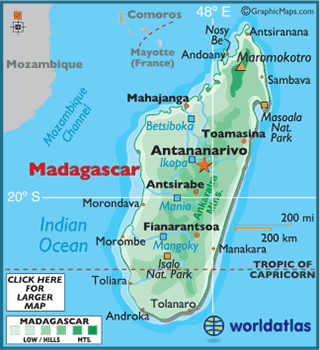

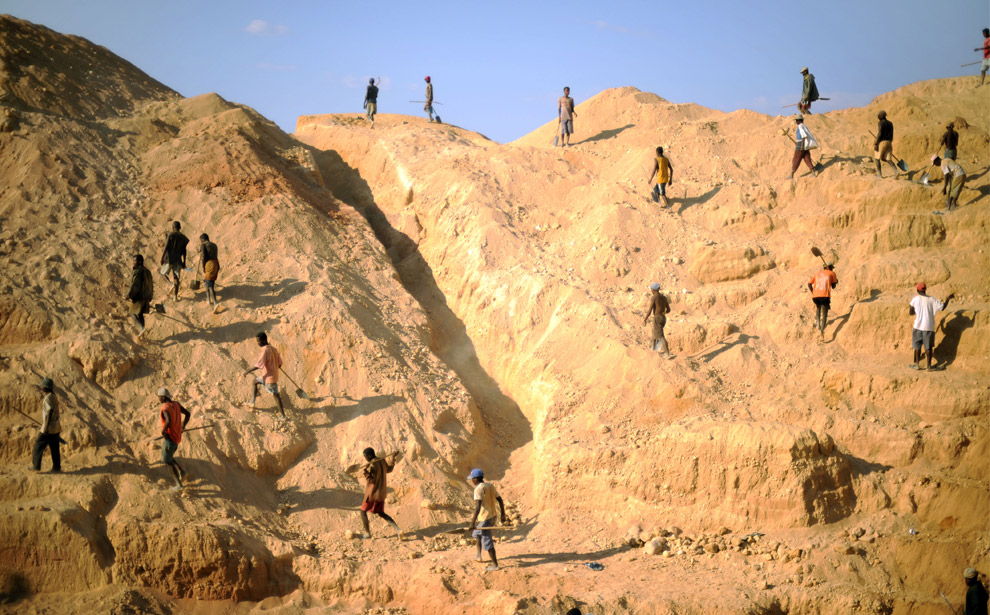
The sapphires were first discovered in 1998 and, since then, the mining for the gems has been mostly unregulated. The mining occurs primarily in the towns of Ilakaka and Sakaraha. Within these towns, Malagasy children, some young as eight years old, are used to extract the gems. The process of mining not only involves child labor but it damages the environment as well (Gale 2003).
Children are used in the mines because of their small size

First, before mining can begin, forests must be cleared away. Second, during mining, large amounts of dirt and soil are thrown into lakes and rivers, causing breathing and habitat problems for local animals. Third, the people working on the mines are provided little food and must hunt animals such as the lemur for food. Finally, there are indirect problems created by the existence of the mine including the rise of pollution in the air caused by an increase in fuel use (Baker, DeLeon, and Tilghman 2005).

Some of the money earned from the gem mines is used for building new schools and improving the state of living for those in Madagascar, however, there are more and social costs as well.

Illakaka
The majority of the miners are from Madagascar, however, people from “Thailand, Sri Lanka, South Africa, the US, Hong Kong, and Europe” (Sengupta 2006) have all sought profit from the sapphires. With the unregulated market, the gem trade is laden with crime (Sengupta 2006) including outsiders smuggling gems from Madagascar to earn a profit, stealing much needed wealth from the country (2003).

In addition, the desire for the money provided by the sapphires leads many people to forgo their usual livelihoods, causing deeper poverty (Baker, DeLeon, and Tilghman 2005). The image conveyed to people is one “ likened to the American Wild West” (Hamilton).

In a attempt to correct the situation, the government, from the Ministry of Energy and Mines (MoM), created the Mineral Resources Governance Project (PGRM) with $32 million dollars funded by the World Bank, a multilateral institution (Miller 283 2010). The Mineral Resources Governance Project founded the Institute of Gemmology which allows those in Madagascar to learn about,” the art and science behind gemology and lapidary processes”(Baker, DeLeon, and Tilghman 2005).

Woman learning how to make cut stones
Another program, called the Business and Market Expansion Program (BAMEX), was also created and supported by the U.S. Agency for International Development (USAID) (Baker, DeLeon, and Tilghman 2005).

Those in the Mineral Resources Governance Project and in the Business and Market Expansion Program (BAMEX) seek to improve the living situation of those in Madagascar by managing and regulating the gem market.
Some of the regulations created by these projects include:
  • Environmental Regulations~ Permit holders are required to pay for environmental impact statements and submit compatibility and commitment plans for rehabilitation projects to the MoM before they are given approval to start exploration or mining; While permit holders are given rights to use wood, water and other resources on the property for their work needs, they are forbidden from mining inside parks or within 80 meters of private property, villages, communal wells, sacred sites, “art masterpieces” etc.
  • Social Regulations ~Permit holders are required to exploit resources as efficiently as possible and must provide potable water, health care, first aid and evacuation services to diggers and other workers; Populations living near mining areas have the right to solicit help from the MoM to protect themselves or their communities from mining activities that present a danger such as a loss of a water source or a communication line. (Baker, DeLeon, and Tilghman 2005).
However,these regulations are not enforced consistently and the goals of both the PGRM and the BAMEX mostly concern the large scale mining for economic profit of Madagascar. Further, the majority of mining occurs illegally (Baker, DeLeon, and Tilghman 2005). Issues facing the environment and local miners are still a concern.


There are some helpful organizations attempting to correct the issues neglected by the government.

NGOs, or nongovernmental organizations, like Forest Stewardship Council, are currently working on bettering the environment through creating certification programs for environmental friendly mining (Baker, DeLeon, and Tilghman 2005).

International aid, in the form of Water Aid, also helps the people of Madagascar by providing sources of clean water.

Madagascar's sapphires have the potential to allow its people to better their country yet the process may take time.

Works Cited
Baker M., S. D. DeLeon, and L. Tilghman. (2005).“Madagascar’s Sapphires” Gems and the Enviroment:Balancing Benefits and Costs. Retreived from http://www.uvm.edu/rsenr/gemecology/madagascar.html.

Gale. (2003, September 18.)"Gem Industry in Need of Regulation." In Africa News Service. Retrieved from Gale World History In Context database GALE|A107889640

Hamilton, Richard. (2003). BBC NEWS. Retrieved from http://news.bbc.co.uk/2/hi/africa/3114213.stm

Miller, Barbara D. (2010). Cultural Anthropology in a Globalizing World. 2nd Edition. Prentice Hall.

Sengupta, K. (2006, November 3). "Gems rush destroys Madagascar's green paradise." In Independent. Retrieved from Gale World History In Context database. GALE|A153719537


Sunday, November 13, 2011

Year of Ireland Event 2

Angela Carroll

COM 360

Dr.Wilson


For my second and final Year of Ireland Event, I watched the movie Kings. Kings features some of the issues present in The Speckled People; however, the identity conflict experienced by the Irish characters in Kings is certainly one which is viewed through adult and immigrant eyes.


The movie Kings focuses on a group of six friends who immigrated, to London, England from Connemara in the 1970s. Joe Mullan, Jap Kavanagh, Git Miller, Shay Mulligan, Máirtín Rogers, and Jackie Flaherty arrive together in London and attempt to get jobs as construction workers. The group of friends all wish to make a fortune and return to Ireland.

Joe


After thirty years however, Joe is the only one who manages to ascend upwards in society as a foreman over other construction workers, yet, he is also addicted to cocaine. Git and Jap live together, jobless, in an apartment and without money. Shay owns a fruit and vegetable stand and has a family. Máirtín has a wife, a job, a daughter, but he also battles with alcoholism.


When it is announced that Jackie, the youngest, has died in a train accident, the friends come together to remember their friend by holding a long, epic Wake at a pub.


Kings / Trailer from High Point Media Group on Vimeo.


Certain moments in the movie really highlight the ties the six men still have with Ireland but also their knowledge that they now belong to England due to their craving for a better life or their ties to their family. The most telling scenes occur during Jackie’s Wake.


The friends mourn the loss of their friend through drink (alcohol). In fact, when Máirtín tells Git and Jap that he wants to stop drinking, Jap interprets this as Máirtín not caring enough about Jackie, “why on this day?” (Kings, 2007) Jap asks him. Through drinking, conflict occurs but conflict which brings about resolution. For example, through the Wake and their drinking, the friends are able to discuss the tension between Joe, the wealthiest among them, and the rest of the friends.


Joe has, essentially, turned his back on his Irish culture due to guilt for not only Jackie’s death but also for leaving his friends. First, he refuses to enter the Catholic Church holding Jackie’s funereal, instead choosing to sit outside in his expensive car in fear of facing Jackie’s father, Micil. He had promised he’d look after his son, who had once saved him from drowning.


Secondly, when finally meeting his friends at a pub, he first refuses to speak in Gaelic. Jap reminds Joe, “Always in Irish” (Kings, 2007).


Finally, Joe admits that he hires only Russian immigrants in construction work. His friends question about this and he explains that, “you can’t get a good Paddy” (Kings, 2007), lumping all Irish immigrants into one category.


Joe is revealed to be purposely turning his back from his friends and his culture. Though he acts somewhat surprised that his friends, Jap, Git, and Jackie, had no employment, Jackie and Git had visited his construction site before Jackie died, asking for work, however Joe refused to see them.


In the beginning, friendship and cultural heritage is seen as the most sacred values among this group, even beyond marriage and family. Martin, for example, speaks to his wife, Maggie, using English though he only uses Gaelic with the other five. He begins drinking again for Jackie’s wake, despite the fact that his alcoholism has led to arguments between Maggie and himself, suggestively even to the point of violence.


Family, however, has also led some of the men to stay in England.


Earlier in the movie, Shay, for example, wants to journey back to Ireland and tells Micil that he intends to, despite the fact that he will have to leave his wife and son. He is told by Micil, “family is where your home is” (Kings, 2007).


By the end of the movie, as the night at the pub continues on, the six friends reflect on their futures. Some still dream of returning to Ireland, including Git and Jap. Yet Shay tells them all that they will never be returning to Ireland, despite their wishes as, “England has given us everything…the only one who is going home is Jackie” (Kings, 2007).


This journey for a home, or an identity, was seen in The Speckled People, however, while Hugo came to the conclusion that he could make his own ‘home’, the men of this movie are unable to find themselves. It’s as if this movie showcases the alternative to Hugo’s resolution.


As the true circumstances surrounding Jackie’s death becomes clear, the friends come to the painful and bitter truth, they can’t give up London, despite the oppression they feel as Irish immigrants. They still have the hope that they may find themselves in a happy life, better than the poverty they left in Ireland. The only way to survive the aimless, uncertainty of their existence in London is to rely on their family and friends.


Works Cited


Collins, T. (Director). (2007). Kings [Film]. Ireland: Newgrange Pictures


Sunday, November 6, 2011

Government and Economy

Angela Carroll
Dr. Wilson
COM 360


We are a capitalist and democratic society in America. In our democratic government system, we are given certain freedoms which are not allowed to people of other countries. Further, we have many choices of what to buy as our economic system allows people, typically within large corporations, to create new products and to compete for our consumption.

Americans consume many, many different forms of product. We consume information, both digital and hard copy, food, clothing, music, art, jewelry, energy, water...and more. There are even entire groups formed around the objects we consume.

Doctor Who, for example, is something I consume. There are books, comics, t-shirts, toys, lunch boxes, costumes, toothbrushes, trash cans, pillowcases, trading cards, video games...well, you get the point.


In fact, corporations count on this sort of near worship of the product. The people behind the product want you and your family to be hooked, for whatever reason, to what they sell you. They want it to become a part of your identity.


This was something that was brought up in a sociology course I had last semester, the idea that the things we consume help define us more than the things that we do and the people we choose to be our friends and even spouses.


For example, my obsession with Doctor Who is certainly odd by many people's standards; however, consider the entire sports culture of America, namely football.

The football stadiums and the team themselves take a lot of money to upkeep (all the water required to keep the field green, the equipment...etc.), yet more money is spent by the millions of people who enjoy it. People buy t-shirts, lunch boxes, video games, car decals, flags; watch numerous sports' channels, and the like, all to show their love for their favorite team.


It becomes a defining part of a person's personality. A person might label themselves with one teams' stuff.


Imagine, for a moment, one person who likes Doctor Who, and another who likes sports. The two might never become close because of their different interests.


I know, from personal experience, when listening to someone talking about football plays, my eyes glaze over from both boredom and confusion. I've also recognized the concerned looks by others when I start talking about Doctor Who to a person who's never seen the show.

Now, don't get me wrong here. There are other things that make up a person's identity (home life, work, school). I like Doctor Who, for example, but I also like playing sports, writing, drawing, or just sitting outside.


But it seems as though objects of our consumption are becoming objects which defines us.


America is, at large, a consumer culture, one with infinite needs that requires more and more resources to continue (Miller 60). The system is expanded by reaching out across oceans and country lines to reach what we need be it labor, water, oil, wood, and even new consumers.

This demand for materials certainly affect what sort of policies the people in the American government have followed in the past and follow now in the present. Just one example can be found in the back and forth admittance of workers from other countries, including from Mexico.


Currently, in America, there is a huge demand for people who are willing to work long and grueling hours on farms. Farm workers exploit the needs of the migrant workers, often from places such as Mexico and Guatemala, to save money (Miller 61).


In the past, the American government has repeatedly welcomed people from Mexico to be laborers, only to force them to return when times are tough. During the Second World War, the United States government actually passed programs to contract workers, or braceros, from over the border to work on farms in place of many of the men who were fighting overseas (Schafer 241).

In times of economic turmoil, such as in the Great Depression, problems facing society can be blamed on minorities. For Mexican immigrants, both legal and illegal, this means being targeted unfairly.


In 1954, to stop illegal immigration, President Eisenhower commenced a program, titled “Operation Wetback” that had been vetoed previously in 1952 by President Truman on the

grounds that the program was immoral (García 2009).


The overt purpose of the policy was to stop all illegal immigration, however, as evidenced by the derogatory name of the operation, the project itself focused mainly on all Mexican people and those of Mexican descent.

Legal Mexican immigrants or even people who seemed to be Mexican, were apprehended and interrogated while illegal Mexican immigrants and their families, including some legal immigrants, were repatriated, or sent back to Mexico (Schafer 240).


President Eisenhower's program was stopped, however, since then, there have been other policies performed by both the national goverment and the state. There is concern that these programs organized to control the border actually cause more illegal immigration due to legal immigration becoming more difficult (Schafer 240).


The freedom given to us through the economy and in government gives many of us a relatively comfortable life. Yet, we must be aware that this comfortable life is also made by exploiting others.


Works Cited


Garcia, J.(2008). In J. H. Moore (Ed.). "Operation Wetback". Encyclopedia of Race and Racism (Vol. 2, pp. 385-388). Detroit: Macmillan Reference USA. Retrieved from Gale U.S.A History in Context database.

Miller, Barbara D. (2010). Cultural Anthropology in a Globalizing World. 2nd Edition. Prentice Hall.

Schaefer, R. T. (2010). Racial and ethnic groups. (12th ed.). Upper Saddle River: Prentice Hall.

Sunday, October 23, 2011

Communicating, Religion, and Art

Angela Carroll

Dr. Wilson
10-23-11
COM 360

Think, for a moment, about the various ways we communicate in our culture and how it has changed over the years. In the past, communication was primarily limited to those around us and who we could walk to. With the rise of technology, our ability to connect, converse, and to convey ourselves has expanded. Such growth in the methods of communication, “the process of sending and receiving messages” (Miller pg. 190, 2011), and the explosion of globalization has allowed our ideas, religions, and our art to be both exposed to, and to influence, other cultures.

The ways in which people communicate differ depending on the culture you belong to as well as the context which influences which type of multiple ways to communicate is used. In the American culture, for example, it is generally accepted among many that one must make eye contact when speaking to another person face to face. Looking away is generally considered rude (Miller pg. 194 ,2011). Further, it’s not considered proper to touch another person unless they are related to you or you know them very well.

Among some in Japan, eye contact can be considered rude (Miller pg. 194 ,2011).
In many cultures, clothes are also used to convey meaning. In America, one wears a suit to look wealthy and successful. In Kuwait, women cover their heads to mark themselves as wealthy (Miller pg. 195, 2011).

As technology has progressed, new routes of communication have opened, each with their own etiquette. In America, ‘texting’, like email but faster and over cellphones instead of computers, is a way to stay connected, especially among young people. Texting while one is class is also very popular but not smiled upon by professors.

E-mail, older than texting, can be done over the Internet. Though it is not as ‘quick’ as texting, e-mailing allows one to send documents and large amount of data across the web. E-mail is considered more professional and used in working environments. When e-mailing another person, one must be sure to include information in the subject line to allow for easy reading. The person receiving your e-mail isn’t going to go through each message they receive and might send yours to the trash bin.

One form of commutation which includes the Internet as well as television, books, and other formats is media. Media reflects the ideas and beliefs of a culture; however, it can also contribute to the way reality is understood.

Again, through framing, a media outlet can portray an event, a person, a country, and even an entire culture, in a certain light.

For example, one popular image existing in television is the idea of the gay best friend, a gay man who is ‘friends’ with a rich, white, often single woman. These men are especially feminine and talk about nothing but fashion, sex, and guy problems.

Are some gay men like this? Sure. But are all of them? NO!

There has long been a similar trend in the portrayal of black characters in television being used as comedic, helpful, plot devices, a subject that is further explained by Eric Deggans on npr.

Media is just one area where a person orients their understandings of the world. Religion, “beliefs and behavior related to supernatural beings and forces” (Miller Pg. 212, 2011), can also be a main factor in shaping how a person thinks.

Religions can include sacred rituals, myths, ‘stories about supernatural forces or beings’ (Miller, Pg. 213 2010) doctrine, “direct statements about religious beliefs” (Miller, Pg. 213 2010), and the beliefs and actions of those involved.


Myths, as found in the Irish storytelling from an earlier post, can be used to pass on morals and values. Doctrines are written like as found in the Holy Bible or the Qur’an and explicitly state what should be done and should not be done (Miller, Pg. 215 2010).

Although rituals can be sacred, like the foot washing in some Christian churches, they can also be secular. An example of a secular ritual can be found in Comic-con. Held annually in Los Angeles, Comic-con was once considered by geeks, nerds, and others as the “Nerd Prom”.


Comics are also a form of cultural expression and used to communicate. They, like other forms of medium, can be considered to be a form of art. Art comes in two forms, fine art and folk art. Fine art,“ produced by artists usually trained in the Western classical tradition” (Miller pg.236, 2010) while folk art is considered to those without such characteristics.

My grandmother has a particular fondness for folk art, coming from the Appalachia region where there is a great amount of art from different cultural backgrounds produced. She enjoys reading the Fox Fire books which detail the culture of Southern Appalachia. Folk art from the Appalachia region includes pottery, dolls, quilts, paintings, carved knives, and many, many other objects.
Another love for my grandmother is traveling for leisure, or traveling for no reason and without rules (Miller pg. 243, 2010). She loves traveling so much, she often spends hours online researching vacation spots. My grandmother, however, restricts herself to places she is familiar with as she is aware of the methods tourist destinations use to attract people.

Using framing, advertisements hide much of the reality behind their choice of frame. Instead, they attempt to communicate to possible customers of the safe, relaxing, and 'authentic' time available within their country (Miller Pg. 245, 2010). Often, the suffering of the people are minimized as well as their diversity.

One such example can be found in the documentary Life and Debt , a video on the true reality facing many of the Jamaica people.

Works Cited
Miller, Barbara D. (2010). Cultural Anthropology in a Globalizing World (2nd ed.). Prentice Hall: New York.

Thursday, October 20, 2011

Spooky Irish Tales: A Ireland Year Event

Angela Carroll
Dr. Wilson
COM 360
11-20-11

At Reinhardt University, we celebrate a different culture every year by holding various events. For 2011, we are celebrating Irish culture and one of the events held , for the Halloween celebration, was the “Spooky Irish Tales”. Story-teller Betsy Doty, who has long told stories throughout her life, including in a homeless shelter, came to our school.

Besty Doty used an active, theatrical method in her story telling rather than simply speaking from her chair.

She stood and walked, used hand gestures, and changed her voice with each character. Her stories, like many stories, used repetitive phrases, rhythms, and hand motions. Doty told four Irish stories, each had their morals and could be used to obtain insight into the Irish culture, as myths typically do (Miller pg.213, 2010).

I will share the basics and some cultural insights for three of the stories with you.

The first story she told us was the tale of Mr. Fox, though, she admitted that it was a story with unknown origins. The phrases within it, including ‘much to do about nothing’, led many to believe it too be originally English, however, the Irish claim the tale to be stolen from the Gaelic tales(Doty, storytelling 2011).

“Mr. Fox” is known as a “Blue-beard tale” in that it is a tale about the dangerous of trusting a wealthy, seemingly God-fearing man you know little about. It is a story aimed primarily towards young female listeners.

In “Mr. Fox”, a young woman named Mary fell in love with a red haired man called Mr. Fox and they plan to marry after knowing one another for two weeks. While Mr. Fox is away, Mary journeys behind the church in search of the castle Mr. Fox told her they would move to after the wedding.

I’m not going to completely ruin the story for you, however, just know that Mary finds a grotesque secret and runs home(Doty, storytelling 2011).


It involved a barrel of blood


The story could reflect the patriarchal structure and the importance of family in Ireland. Mary, a female, wanders alone to Mr. Fox's castle and faces terrible danger. It is only when she returns to her family where she is safe (and Mr. Fox is dealt with by her brothers).

Then again, because it is Mary who turns the tide against Mr. Fox in the end, it could just easily reflect a wariness of red haired people who promise things which are ‘too good to be true’.

The second story was a result of the actions, as Doty informed us, by W.B. Yeats, Lady Gregory, and Lady Wilde during the late 1800s. Around the 1850s, development was occurring via the railroads. Gaelic language was in danger and so too was the Irish culture. A way the wealthy and educated sought to save the Irish ways was by going into the rural areas and finding stories. W.B Yeats published Fairy Tales of the Irish Peasantry .


Moo!


After asking the help of a priest and and a 'fairy woman', Brian is forced to go another night with the mystery of his sick cows another day. That night, however, he is visited by an old woman who he gives food and shelter to. She offers to help him, using witchcraft by asking him to get the first cow he sees and bringing it to her.
The old woman sings a song over a fire while the Brian and his wife churn butter out of the bad milk.

A person knocks on the door and the old woman says that this is the person who has placed a spell on the farm. When they open the door, Rachel Higgins, another farmer and their neighbor, is standing there. She owns fewer cows than Brian yet still has better business than all the other farmers.

After Brian helps Rachel Higgins, the old woman tells him to go to the field with dogs and other men and to chase whatever they find. Brian brings his other neighbors and their dogs to his field and they find a giant hare, sucking the milk from the cows... (Doty, storytelling 2011).


Rawr!


Again, I don't want to completely ruin the story, however, notice the repeat of themes. The tales are not only for entertainment, but for moral lessons. In both stories, there is an important lesson of: “ Don't trust appearances, evil can take many forms.”


Not this blatantly obvious...


Further, there is also a fondness for supernatural tales. The final story Doty told us was the tale of the Banshee.

A banshee travels the night, searching for another lonely soul to take with her back to the underworld. Once she stops by a nursery, finds a baby who has been left alone, and takes the infant.


Throughout the night, she continues to look for other souls to steal, however, each time she is forced to turn back because of kindness. For example, she approaches a blacksmith closing down shop and is about to take his spirit, yet, his cat enters the house and wraps herself around his leg.


I savz yur sol?


In the end, the Banshee must leave because of the coming light (Doty, storytelling 2011). Again, evil is beaten and light, both metaphorical and physical, save the day.

Works Cited
Doty, Betsy. (2011). Spooky Irish Tales. Storytelling. Reinhardt University.
Miller, Barbara D. (2010). Cultural Anthropology in a Globalizing World (2nd ed.). Prentice Hall: New York.


Friday, October 7, 2011

The Speckled People

Angela Carroll
COM 360
10-7-11
Dr. Wilson

The Speckled People

Hugo Hamilton's book, The Speckled People is a memoir, detailing his childhood in 1950s Dublin, Ireland. As a child with parents from two differing cultural backgrounds and as a Irish-German boy growing up in a rapidly changing world, The Speckled People is Hamilton's account of, not only his struggle to find his identity, but the struggles of his German mother, Imgrad Kaiser, and his Irish father, Jack Hamilton.


Hugo is trapped between his father's demands that he be the 'weapon' for the Irish people, his mother's gentle advice to survive and be a good person, and the rising influence of England and America. In The Speckled People, Hugo faces hatred for his German blood from his peers and anger from his own frustrated, culturally vulnerable father. He grows up in the aftermath of two nations, Ireland and Germany, struggling to find themselves, and feels the effects of the First World War, the Holocaust, and Southern Ireland's recent gained independence.


Hugo is affected by his links to both Germany and Ireland as the two countries have dealt with their own cultural identity crisis. Ireland, the land of his father, had long been dominated by the English empire since the twelfth century (Gale 2007). Hugo's home town of Dublin was once the city where the English army was kept as they battled against opponents of the English control.


A great source of the divisions between the Irish and the English people came in the battle between the foreign Protestant religion and native, Roman Catholicism. From 1541, when King Henry the eighth placed a Protestant church in Ireland, policies were used to oppress Roman Catholics and favor Protestants, policies which also contributed to the Potato famine in the 1800s (Wilson 2011).

Events such as the Potato famine and the continued oppression from the English led those who supported Home Rule, nationalists, to continue to revolt against those who favored colonialism, Unionists, often in a violent manner.


There was still a sharp divide between Protestant North Ireland and Roman Catholic Southern

Ireland. Separatists groups, such as the Sinn Fein, believed in forming Ireland into its own independent nation and fought many years to gain control. Northern Ireland, would remain in control of the United Kingdom until 1999, however, in 1949, Southern Ireland finally gained independence from England as the Republic of Ireland.


The impact of German bombing and the overall toll of the Second World War on England gave the separatists a winning advantage (Gale 2007).


Hugo's father, Jack Hamilton, comes from the Southern Ireland city of County Cork (Hamilton 111) and is the product of the culture war between the English and Irish. He retaliates against the growing influence of the English and American culture by forbidding; television, comic books, and, most importantly, the use of the English language, even from American and English music, from the house.


Jack instance on being called Sean Ó hUrmoltaigh and forbidding English from his family is more than a simple preference. Jack is on a mission to make Ireland a strong, unified nation, and, himself, the perfect Irishman, using his children as weapons, “He said we were the new Irish children and soon the whole country would be speaking Irish in the shops” (Hamilton 133).


Jack Hamilton, during most of Hugo’s childhood, was a man who attempted to help Ireland and his family by surrounding his children with German and Irish culture, keeping bees (Hamilton 284), by selling Irish and German based goods (Hamilton 107), and by working as an engineer, providing electricity to rural places in Ireland, including Connemara (Hamilton 288).

Jack’s past, however, which he hides in a wardrobe in the house, holds a different identity for Hugo’s father. Within the wardrobe, Jack keeps the source of his childhood harassed by other children and the feelings of shame, the evidence of his father’s, John Hamilton (Hamilton 12), service in the British Navy during the First World War.

Jack’s rebellion against both his father’s memory and the effects of the English occupation in general, led him to idealize the German culture, make speeches on O’Connell street in Dublin (Hamilton 38), and form a nationalist party and a nationalist newspaper both titled Aiséirí, with a friend named Gearóid.

When Jack is at work, Imgrad goes through the wardrobe and finds a 1946 copy of the Aiséirí newspaper, revealing that Jack’s speeches promised, if brought into power, Aiséirí would restore their nation by ridding Ireland of everyone who was not Irish, including Jewish people (Hamilton 253), similar to the Nazi’s promises in Germany.

His refusal to accept an English name and the greater assimilation process occurring in Ireland reflects his desire and the desires of Irish nationalists in general, to preserve the Gaelic language and culture from becoming extinct (Miller 206).


Germany, the land of Hugo's mother, was also faced with a long battle to discover its own identity. After the First World War, Germany was forced to sign the Treaty of Versailles, according to which, the nation lost territory, was forced to put limits on its military, forbidden to join Austria, and endure occupation by Allied forces, including military from England and America (Keylor 2006).


The rise of the Nationalist Socialist German Workers' party, or the Nazi’s, was in part, due to many in Germany wanting to feel a sense of pride, safety, and unification in Germany once again (Gale 1988). Hitler took advantage of a hurting country and began writing and making speeches promising success and a strong nation once more.


Scapegoats were made of the Jewish people, homosexuals, the Roma, and numerous other groups who were killed by men such as Adolf Eichmann in the Holocaust, the 'solution' given by the Nazi's to Germany's problems.


During the extreme nationalistic policies of Hitler, the people of Germany were divided between members of the Nazi party, some joining only to survive, and the targets of the Nazis. Those who fought back openly were typically killed or sent to the camps.


Resistance against the controlling Nazi party did occur, including Claus Schenk Graf von Stauffenberg, who, in 1944, attempted to, but failed, to kill Hitler using a bomb (Gale 1994).


Following the Nazi's defeat in 1945, Germany was faced with the horrifying reality of the crimes of the Holocaust and the stigma placed on all Germans which resulted from the actions of a few. Further, Germany was divided into occupation zones which eventually led to the division between Communist East Germany, controlled by the Soviet Union, and the Democratic West, controlled by American, French, and England, after the war (Gerhard 2006).


Imgrad Kaiser, coming from Kempen, is in a battle to accept her cultural identity which parallels Germany’s desire to enjoy its strong nationalist pride but to face the horrors of the Holocaust. In sharp contrast to Jack’s message of fighting back against assimilation, Imgrad tells her children, “…you can’t be still trying to stop things after they’ve happened” (Hamilton 153). She listens to American music when her husband is at work, including, ‘Roses Are Red, My Love, Violets Are Blue’ (Hamilton 78).

Imgrad also encourages her children to be positive and to use of the ‘silent negative’ of Hugo’s Onkel Gerd against injustice, “Nobody can force you to smile” (Hamilton 145). From seeing and living in the results of extreme nationalism and intolerance to different cultures, Imgrad is far more accepting of the English and American culture as well as more adapted to coping with difficult challenges in life.


Though she is homesick for her home in Germany and proud of her German culture,she still has the painful memories of her time under the Nazi regime. While in Nazi Germany, Imgrad, like many Germans, were controlled by the fear of being killed, however, Imgrad and many of her family members learned to resist.


Imgrad and her sisters were raised by, following the death of her parents,their uncle Gerd and his wife taught her and her four sisters how to fight back by seeming agreeable on the surface but, underneath, be really finding other ways of resisting. Imgrad's uncle resisted by refusing to join the Nazi party (Hamilton 67) and Imgrad's sister, Marianne followed suit, by hiding Jewish people in her guest house (Hamilton 265).


Imgrad resists silently, even after being raped by her employer, Herr Steigler, until she is able to flee Germany to go to Ireland, only to be trapped again by her nationalist husband (Hamilton 289).

Finally, Hugo himself is the center of his own identity crisis, as those with multicultural roots can often experience. Being taught the two different lessons of his German mother and Irish father, Hugo feels torn between the two cultures and isolated.


He is comforted by the caring, gentle ways of her mother, however, he is stigmatized by the crimes of the Nazi's by other people, including other children, “But the boys outside the shops can see us wearing lederhosen, so they call us Nazis” (Hamilton 135).


Hugo sometimes wishes he was Irish to avoid being made fun of yet, he does not want to match the extreme ideal his father wishes to have as this also distances him from his peers, “You couldn't be cowboys in Irish” (Hamilton 190). It is only when Hugo's parents take him two different extremes of his culture, one in An Cheathru Rua, a rural Irish town, and the other in Kempen, his mother's home town, that he is able to feel at peace.


Hugo, however, lives in Dublin, a large city where there is diversity and advancement, and, as a result, must learn to cope with the transforming multicultural changes occurring. To face this conflict of identity and the scorn of his peers, Hugo could be as his father taught, a violent man similar to the Nazi's, “I laughed like the Nazi's in the films and would not let him up...”(Hamilton 281), or he could be a silent resistor as his mother and her Onkel adivsed, “He was doing what my mother always told said we should do, to pretend they didn't exist” (Hamilton 140).


Eventually, Hugo comes to his own method of dealing with both bullies and his identity crisis, “I'm walking on the wall and nobody can stop me” (Hamilton 295), he resists living up to a cultural ideal. After Jack is killed by his own bees, Hugo and his mother go on a small journey to find themselves, however, in the end, they find that they “were lost” but that, “...it didn't matter” (Hamilton 298).


Works Cited
Keylor, W. R., & Merriman, J. & Winter. J. (Eds.).(2006)."Versailles, Treaty of."Europe Since 1914: Encyclopedia of the Age of War and Reconstruction. (Vol.5.). Detroit: Charles Scribner's Sons. Retrieved from Gale World History In Context database. (GALE|CX3447000884).

Gale. (1994). "Leaders of the German Resistance to Hitler."Historic World Leaders. Detroit: Gale. Retrieved from Gale World History In Context. (GALE|K1616000019)

Gale.(1998) ."Hitler, Adolf (1889-1945)."Encyclopedia of World Biography. Detroit: Gale.Retrieved from Gale World History In Context database. (GALE|A148463479).

Gale. (2007). “Religious Politics: Northern Ireland and England.” Prejudice in the Modern World Refrence Libarary. (Vol.2). Detroit: UXL. Retrieved from Gale World History In Context. (GALE|CX2831400034).

Hamilton, Hugo. (2004). The Speckled People. New York: HarperCollins.


Horne, J., & Winter, J, Merriman, J. (Eds.). (2006). “World War I."Europe Since 1914: Encyclopedia of the Age of War and Reconstruction. (Vol.5.). Detroit: Charles Scribner's Sons. Retrieved from Gale World History In Context database. (GALE|CX3447000917).

Miller, Barbara D. (2010). Cultural Anthropology in a Globalizing World. 2nd Edition. Prentice Hall.

Weinberg, Gerhard L. & Merriman, J. & Winter, J. (Eds.). (2006)."World War II."Europe Since 1914: Encyclopedia of the Age of War and Reconstruction. (Vol. 5.). Detroit: Charles Scribner's Sons. Retrieved from Gale World History In Context database. (GALE|CX3447000918).

Wilson, Pam. 2011. Ireland History. [Class Lecture].

Tuesday, September 27, 2011

Thoughts on my Cultural Roots


Angela Carroll
COM 360
Dr. Wilson
9-27-11


It’s amazing to me the sheer amount of difference between me and my very ‘Southern’ ancestors. Just to list a few, we have differences in our: ways of living, beliefs, values, environment, ways of enjoying ourselves, and the foods we eat. On the other hand, my ancestors do have some things in common such as the celebrations we enjoy and our love of nature.

I find unsettling to think that some people I’m related to owned slaves and fought on the Confederate side of the Civil War. Though, I’m also proud to say that some of my relatives worked crops on farms, made clothing in their own homes, and lived through the Depression and times of war while taking care of their many children.

At least the ancestors on my mother’s side and many of my family today come from the Appalachia Mountain region. Yes, I admit, some of them live and have lived similarly to those in the documentary we saw in class, however, most do not.

My great grandmother’s father, my great-great grandfather, George Vendable Stancil, for example, owned his own home and had a farm, complete with cows, chickens, pigs, and even a mare.

Both my great-great grandfather and great-great grandmother, Aida Josephine Stancil could also read and write and taught their three children how to read and write as well, despite not going to school themselves.

The Stancils were, like almost all of my ancestors, mostly agrarian and worked on a farm, children included. George and his family worked in the fields collecting vegetables to sell in the market. Ada also made nearly everything at home including clothing, pillowcases, jam, smoked pork, and soap.


Our shared love for jam=awesome!

My grandmother Grace remembers having to get up early in the morning and working some at the farm before walking several miles into the center of town to attend school. Young children were expected to work like the adults, unlike in today’s American culture.


Free Loader!


Agrarian families tend to have many children because children are a source of help on the farm and can help take care of their parents. Pronatalism, “an attitude or policy that encourages childbearing”, was apparently a common theme in the culture of my ancestors (Miller 78).As an agrarian family (and also possibly because of my ancestor’s Southern Baptist religion) my ancestors tended to have many children.

George and Ada had only three daughters due to the difficulty with the Great Depression and various wars during their life time and because of the decrease in need for extra hands (Miller 78). George’s mother and father, Elizabeth and Cader (or Cade) Stancil, on the other hand, had a total of eight children while, according to my grandmother, Ada’s mother, known only as Mrs. Anderson, had a total of eleven children.

Speaking of my great-great grandfather Cader Stancil and my great-great grandmother, Mrs. Anderson, I think it’s time to briefly discuss the more disturbing parts of my cultural roots. Of course, I try to keep cultural relativity in mind but I, as a product of the more open culture, can’t help but feel a sense of revulsion.

Cader Stancil was a soldier who was a solider in the Confederate army and was enlisted in the 52nd Georgia Infantry Regiment in Company C. I can’t exactly say what Cader Stancil’s motives were in joining the army. He could have felt pressured to do it or he could have simply felt that people should keep slaves, I might never know.

Mrs. Anderson, on the other hand, was definitely for slavery. From what my great grandmother and my grandmother, Linda, have told me, Mrs. Anderson and her family were rather wealthy and owned three-hundred acres of land, a big farm, and slaves. Now, according to my grandmother and great-grandmother, as wealthy people, Mrs. Anderson and her family were the “nice” slave owners.


The Andersons apparently owned other human beings to tend to their domestic needs such as cleaning and cooking and even gave them a small house in the backyard to live in. Great grandmother Grace told me that the Andersons released the slaves but that, “…they wanted to stay.”

Now here’s another source of cultural differences between me and some of my family and that is our perceptions of the reality of slavery. I suppose it may be a product of my education and the times I’ve been raised in but I don’t feel the need to defend people who owned other human beings. I’m able to practice cultural relativity and understand why they did what they did and the context of which they did it in, but I’m not about to attempt to dilute the truth.

At least some of my ancestors owned other human beings.

I doubt that the people who were owned for several years, had nothing but the clothes on their backs, and had nowhere else to go, chose to stay where they were guaranteed food and shelter because the people they served were kind owners, but, really, can I ever be sure?

As appalling as some of my cultural roots are, as twisted and covered with thorns as they can be, there are some more appealing things and people I’m proud of. I respect my great-great grandparents, George and Ada Stancil and the way of life they led.

Of course, I can look down the strict division of labor they followed, like Ada being responsible for all the cooking and making all those pillowcases, and the way they punished their children,behind closed doors and with a 'switch', I too remember this method of punishment.

But I also realize that they laid the groundwork for what I am today. I realize that, like it or not, with all the good and bad that comes with it, I’m of the Appalachian background.


Miller, Barbara D. (2010). Cultural Anthropology in a Globalizing World (2nd ed.). Prentice Hall: New York.