Angela Carroll
Dr. Wilson
COM 360
Development is defined by Miller as “ directed change aimed at improving human welfare” (pg.278 2010). Changes, such as programs aimed at creating better living conditions and easier access to water, can be a form of development. Yet, there are other forms of development can have harmful effects.
An example of a land being negatively impacted by the extractive industry, which “explores for, removes, processes, and sells minerals, oil, and gas the are found on or beneath the earth's surface and are nonrenewable” (Miller 296 2010) is Madagascar.
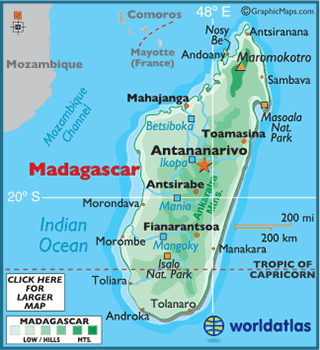
Madagascar is an island located in the Indian Ocean and is home to the many animals, including the lemur (Miller 288 2010), and the Malagasy people. Madagascar is also one of the largest source of sapphires in the market (Hamilton, 2003) but, despite the amount of mining within the country, Madagascar is one of the poorest (Sengupta 2006). Seventy-two percent of the people of Madagascar live “below the poverty line” (Sengupta 2006).

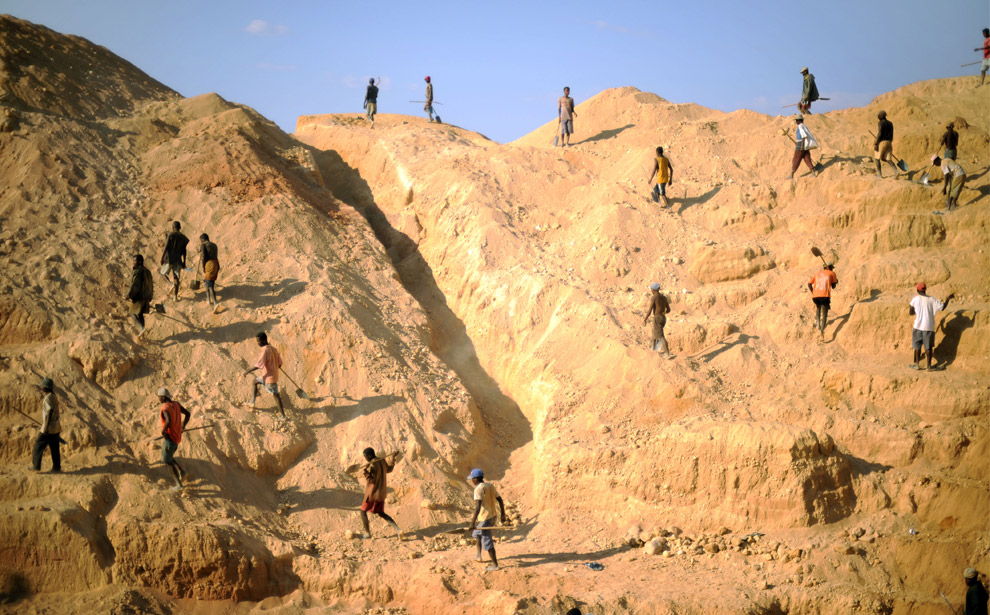
The sapphires were first discovered in 1998 and, since then, the mining for the gems has been mostly unregulated. The mining occurs primarily in the towns of Ilakaka and Sakaraha. Within these towns, Malagasy children, some young as eight years old, are used to extract the gems. The process of mining not only involves child labor but it damages the environment as well (Gale 2003).
 |
| Children are used in the mines because of their small size |
 First, before mining can begin, forests must be cleared away. Second, during mining, large amounts of dirt and soil are thrown into lakes and rivers, causing breathing and habitat problems for local animals. Third, the people working on the mines are provided little food and must hunt animals such as the lemur for food. Finally, there are indirect problems created by the existence of the mine including the rise of pollution in the air caused by an increase in fuel use (Baker, DeLeon, and Tilghman 2005).
Some of the money earned from the gem mines is used for building new schools and improving the state of living for those in Madagascar, however, there are more and social costs as well.
 |
| Illakaka |
The majority of the miners are from Madagascar, however, people from “Thailand, Sri Lanka, South Africa, the US, Hong Kong, and Europe” (Sengupta 2006) have all sought profit from the sapphires. With the unregulated market, the gem trade is laden with crime (Sengupta 2006) including outsiders smuggling gems from Madagascar to earn a profit, stealing much needed wealth from the country (2003).
In addition, the desire for the money provided by the sapphires leads many people to forgo their usual livelihoods, causing deeper poverty (Baker, DeLeon, and Tilghman 2005). The image conveyed to people is one “ likened to the American Wild West” (Hamilton).
In a attempt to correct the situation, the government, from the Ministry of Energy and Mines (MoM), created the Mineral Resources Governance Project (PGRM) with $32 million dollars funded by the World Bank, a multilateral institution (Miller 283 2010). The Mineral Resources Governance Project founded the Institute of Gemmology which allows those in Madagascar to learn about,” the art and science behind gemology and lapidary processes”(Baker, DeLeon, and Tilghman 2005).
 |
| Woman learning how to make cut stones |
Another program, called the Business and Market Expansion Program (BAMEX), was also created and supported by the U.S. Agency for International Development (USAID) (Baker, DeLeon, and Tilghman 2005).
Those in the Mineral Resources Governance Project and in the Business and Market Expansion Program (BAMEX) seek to improve the living situation of those in Madagascar by managing and regulating the gem market.
Some of the regulations created by these projects include:
- Environmental Regulations~ Permit holders are required to pay for environmental impact statements and submit compatibility and commitment plans for rehabilitation projects to the MoM before they are given approval to start exploration or mining; While permit holders are given rights to use wood, water and other resources on the property for their work needs, they are forbidden from mining inside parks or within 80 meters of private property, villages, communal wells, sacred sites, “art masterpieces” etc.
- Social Regulations ~Permit holders are required to exploit resources as efficiently as possible and must provide potable water, health care, first aid and evacuation services to diggers and other workers; Populations living near mining areas have the right to solicit help from the MoM to protect themselves or their communities from mining activities that present a danger such as a loss of a water source or a communication line. (Baker, DeLeon, and Tilghman 2005).
There are some helpful organizations attempting to correct the issues neglected by the government.
NGOs, or nongovernmental organizations, like Forest Stewardship Council, are currently working on bettering the environment through creating certification programs for environmental friendly mining (Baker, DeLeon, and Tilghman 2005).
International aid, in the form of Water Aid, also helps the people of Madagascar by providing sources of clean water.
Madagascar's sapphires have the potential to allow its people to better their country yet the process may take time.
Works Cited
Baker M., S. D. DeLeon, and L. Tilghman. (2005).“Madagascar’s Sapphires” Gems and the Enviroment:Balancing Benefits and Costs. Retreived from http://www.uvm.edu/rsenr/gemecology/madagascar.html.
Gale. (2003, September 18.)"Gem Industry in Need of Regulation." In Africa News Service. Retrieved from Gale World History In Context database GALE|A107889640
Hamilton, Richard. (2003). BBC NEWS. Retrieved from http://news.bbc.co.uk/2/hi/africa/3114213.stm
Miller, Barbara D. (2010). Cultural Anthropology in a Globalizing World. 2nd Edition. Prentice Hall.
Sengupta, K. (2006, November 3). "Gems rush destroys Madagascar's green paradise." In Independent. Retrieved from Gale World History In Context database. GALE|A153719537

0 comments:
Post a Comment