BLOGGER TEMPLATES - TWITTER BACKGROUNDS »

Sunday, November 20, 2011

Madagascar and Development

Angela Carroll

Dr. Wilson
COM 360

Development is defined by Miller as “ directed change aimed at improving human welfare” (pg.278 2010). Changes, such as programs aimed at creating better living conditions and easier access to water, can be a form of development. Yet, there are other forms of development can have harmful effects.

An example of a land being negatively impacted by the extractive industry, which “explores for, removes, processes, and sells minerals, oil, and gas the are found on or beneath the earth's surface and are nonrenewable” (Miller 296 2010) is Madagascar.

Madagascar is an island located in the Indian Ocean and is home to the many animals, including the lemur (Miller 288 2010), and the Malagasy people. Madagascar is also one of the largest source of sapphires in the market (Hamilton, 2003) but, despite the amount of mining within the country, Madagascar is one of the poorest (Sengupta 2006). Seventy-two percent of the people of Madagascar live “below the poverty line” (Sengupta 2006).

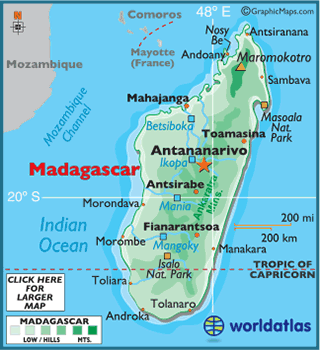

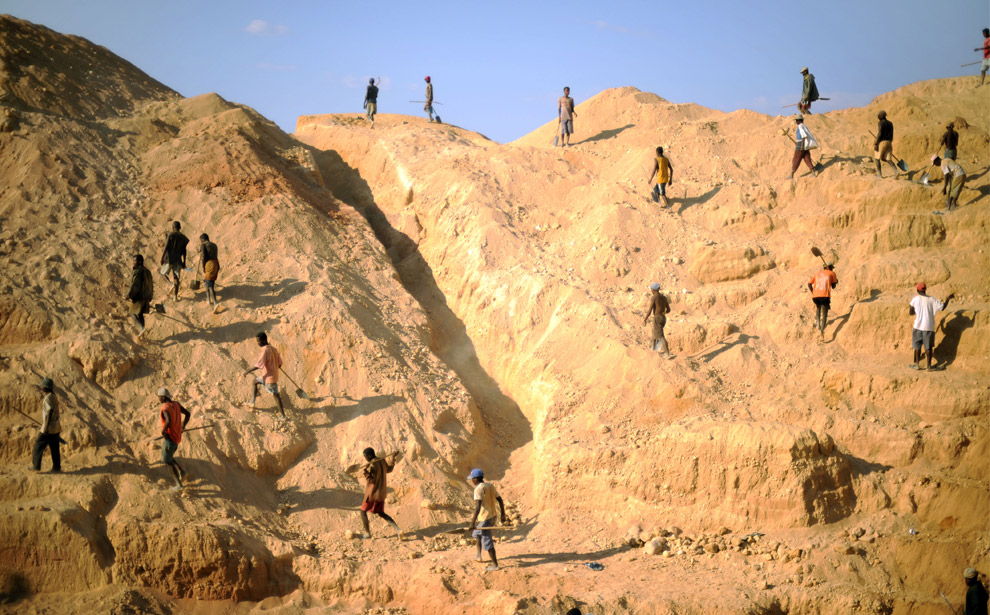
The sapphires were first discovered in 1998 and, since then, the mining for the gems has been mostly unregulated. The mining occurs primarily in the towns of Ilakaka and Sakaraha. Within these towns, Malagasy children, some young as eight years old, are used to extract the gems. The process of mining not only involves child labor but it damages the environment as well (Gale 2003).
Children are used in the mines because of their small size

First, before mining can begin, forests must be cleared away. Second, during mining, large amounts of dirt and soil are thrown into lakes and rivers, causing breathing and habitat problems for local animals. Third, the people working on the mines are provided little food and must hunt animals such as the lemur for food. Finally, there are indirect problems created by the existence of the mine including the rise of pollution in the air caused by an increase in fuel use (Baker, DeLeon, and Tilghman 2005).

Some of the money earned from the gem mines is used for building new schools and improving the state of living for those in Madagascar, however, there are more and social costs as well.

Illakaka
The majority of the miners are from Madagascar, however, people from “Thailand, Sri Lanka, South Africa, the US, Hong Kong, and Europe” (Sengupta 2006) have all sought profit from the sapphires. With the unregulated market, the gem trade is laden with crime (Sengupta 2006) including outsiders smuggling gems from Madagascar to earn a profit, stealing much needed wealth from the country (2003).

In addition, the desire for the money provided by the sapphires leads many people to forgo their usual livelihoods, causing deeper poverty (Baker, DeLeon, and Tilghman 2005). The image conveyed to people is one “ likened to the American Wild West” (Hamilton).

In a attempt to correct the situation, the government, from the Ministry of Energy and Mines (MoM), created the Mineral Resources Governance Project (PGRM) with $32 million dollars funded by the World Bank, a multilateral institution (Miller 283 2010). The Mineral Resources Governance Project founded the Institute of Gemmology which allows those in Madagascar to learn about,” the art and science behind gemology and lapidary processes”(Baker, DeLeon, and Tilghman 2005).

Woman learning how to make cut stones
Another program, called the Business and Market Expansion Program (BAMEX), was also created and supported by the U.S. Agency for International Development (USAID) (Baker, DeLeon, and Tilghman 2005).

Those in the Mineral Resources Governance Project and in the Business and Market Expansion Program (BAMEX) seek to improve the living situation of those in Madagascar by managing and regulating the gem market.
Some of the regulations created by these projects include:
  • Environmental Regulations~ Permit holders are required to pay for environmental impact statements and submit compatibility and commitment plans for rehabilitation projects to the MoM before they are given approval to start exploration or mining; While permit holders are given rights to use wood, water and other resources on the property for their work needs, they are forbidden from mining inside parks or within 80 meters of private property, villages, communal wells, sacred sites, “art masterpieces” etc.
  • Social Regulations ~Permit holders are required to exploit resources as efficiently as possible and must provide potable water, health care, first aid and evacuation services to diggers and other workers; Populations living near mining areas have the right to solicit help from the MoM to protect themselves or their communities from mining activities that present a danger such as a loss of a water source or a communication line. (Baker, DeLeon, and Tilghman 2005).
However,these regulations are not enforced consistently and the goals of both the PGRM and the BAMEX mostly concern the large scale mining for economic profit of Madagascar. Further, the majority of mining occurs illegally (Baker, DeLeon, and Tilghman 2005). Issues facing the environment and local miners are still a concern.


There are some helpful organizations attempting to correct the issues neglected by the government.

NGOs, or nongovernmental organizations, like Forest Stewardship Council, are currently working on bettering the environment through creating certification programs for environmental friendly mining (Baker, DeLeon, and Tilghman 2005).

International aid, in the form of Water Aid, also helps the people of Madagascar by providing sources of clean water.

Madagascar's sapphires have the potential to allow its people to better their country yet the process may take time.

Works Cited
Baker M., S. D. DeLeon, and L. Tilghman. (2005).“Madagascar’s Sapphires” Gems and the Enviroment:Balancing Benefits and Costs. Retreived from http://www.uvm.edu/rsenr/gemecology/madagascar.html.

Gale. (2003, September 18.)"Gem Industry in Need of Regulation." In Africa News Service. Retrieved from Gale World History In Context database GALE|A107889640

Hamilton, Richard. (2003). BBC NEWS. Retrieved from http://news.bbc.co.uk/2/hi/africa/3114213.stm

Miller, Barbara D. (2010). Cultural Anthropology in a Globalizing World. 2nd Edition. Prentice Hall.

Sengupta, K. (2006, November 3). "Gems rush destroys Madagascar's green paradise." In Independent. Retrieved from Gale World History In Context database. GALE|A153719537


Sunday, November 13, 2011

Year of Ireland Event 2

Angela Carroll

COM 360

Dr.Wilson


For my second and final Year of Ireland Event, I watched the movie Kings. Kings features some of the issues present in The Speckled People; however, the identity conflict experienced by the Irish characters in Kings is certainly one which is viewed through adult and immigrant eyes.


The movie Kings focuses on a group of six friends who immigrated, to London, England from Connemara in the 1970s. Joe Mullan, Jap Kavanagh, Git Miller, Shay Mulligan, Máirtín Rogers, and Jackie Flaherty arrive together in London and attempt to get jobs as construction workers. The group of friends all wish to make a fortune and return to Ireland.

Joe


After thirty years however, Joe is the only one who manages to ascend upwards in society as a foreman over other construction workers, yet, he is also addicted to cocaine. Git and Jap live together, jobless, in an apartment and without money. Shay owns a fruit and vegetable stand and has a family. Máirtín has a wife, a job, a daughter, but he also battles with alcoholism.


When it is announced that Jackie, the youngest, has died in a train accident, the friends come together to remember their friend by holding a long, epic Wake at a pub.


Kings / Trailer from High Point Media Group on Vimeo.


Certain moments in the movie really highlight the ties the six men still have with Ireland but also their knowledge that they now belong to England due to their craving for a better life or their ties to their family. The most telling scenes occur during Jackie’s Wake.


The friends mourn the loss of their friend through drink (alcohol). In fact, when Máirtín tells Git and Jap that he wants to stop drinking, Jap interprets this as Máirtín not caring enough about Jackie, “why on this day?” (Kings, 2007) Jap asks him. Through drinking, conflict occurs but conflict which brings about resolution. For example, through the Wake and their drinking, the friends are able to discuss the tension between Joe, the wealthiest among them, and the rest of the friends.


Joe has, essentially, turned his back on his Irish culture due to guilt for not only Jackie’s death but also for leaving his friends. First, he refuses to enter the Catholic Church holding Jackie’s funereal, instead choosing to sit outside in his expensive car in fear of facing Jackie’s father, Micil. He had promised he’d look after his son, who had once saved him from drowning.


Secondly, when finally meeting his friends at a pub, he first refuses to speak in Gaelic. Jap reminds Joe, “Always in Irish” (Kings, 2007).


Finally, Joe admits that he hires only Russian immigrants in construction work. His friends question about this and he explains that, “you can’t get a good Paddy” (Kings, 2007), lumping all Irish immigrants into one category.


Joe is revealed to be purposely turning his back from his friends and his culture. Though he acts somewhat surprised that his friends, Jap, Git, and Jackie, had no employment, Jackie and Git had visited his construction site before Jackie died, asking for work, however Joe refused to see them.


In the beginning, friendship and cultural heritage is seen as the most sacred values among this group, even beyond marriage and family. Martin, for example, speaks to his wife, Maggie, using English though he only uses Gaelic with the other five. He begins drinking again for Jackie’s wake, despite the fact that his alcoholism has led to arguments between Maggie and himself, suggestively even to the point of violence.


Family, however, has also led some of the men to stay in England.


Earlier in the movie, Shay, for example, wants to journey back to Ireland and tells Micil that he intends to, despite the fact that he will have to leave his wife and son. He is told by Micil, “family is where your home is” (Kings, 2007).


By the end of the movie, as the night at the pub continues on, the six friends reflect on their futures. Some still dream of returning to Ireland, including Git and Jap. Yet Shay tells them all that they will never be returning to Ireland, despite their wishes as, “England has given us everything…the only one who is going home is Jackie” (Kings, 2007).


This journey for a home, or an identity, was seen in The Speckled People, however, while Hugo came to the conclusion that he could make his own ‘home’, the men of this movie are unable to find themselves. It’s as if this movie showcases the alternative to Hugo’s resolution.


As the true circumstances surrounding Jackie’s death becomes clear, the friends come to the painful and bitter truth, they can’t give up London, despite the oppression they feel as Irish immigrants. They still have the hope that they may find themselves in a happy life, better than the poverty they left in Ireland. The only way to survive the aimless, uncertainty of their existence in London is to rely on their family and friends.


Works Cited


Collins, T. (Director). (2007). Kings [Film]. Ireland: Newgrange Pictures


Sunday, November 6, 2011

Government and Economy

Angela Carroll
Dr. Wilson
COM 360


We are a capitalist and democratic society in America. In our democratic government system, we are given certain freedoms which are not allowed to people of other countries. Further, we have many choices of what to buy as our economic system allows people, typically within large corporations, to create new products and to compete for our consumption.

Americans consume many, many different forms of product. We consume information, both digital and hard copy, food, clothing, music, art, jewelry, energy, water...and more. There are even entire groups formed around the objects we consume.

Doctor Who, for example, is something I consume. There are books, comics, t-shirts, toys, lunch boxes, costumes, toothbrushes, trash cans, pillowcases, trading cards, video games...well, you get the point.


In fact, corporations count on this sort of near worship of the product. The people behind the product want you and your family to be hooked, for whatever reason, to what they sell you. They want it to become a part of your identity.


This was something that was brought up in a sociology course I had last semester, the idea that the things we consume help define us more than the things that we do and the people we choose to be our friends and even spouses.


For example, my obsession with Doctor Who is certainly odd by many people's standards; however, consider the entire sports culture of America, namely football.

The football stadiums and the team themselves take a lot of money to upkeep (all the water required to keep the field green, the equipment...etc.), yet more money is spent by the millions of people who enjoy it. People buy t-shirts, lunch boxes, video games, car decals, flags; watch numerous sports' channels, and the like, all to show their love for their favorite team.


It becomes a defining part of a person's personality. A person might label themselves with one teams' stuff.


Imagine, for a moment, one person who likes Doctor Who, and another who likes sports. The two might never become close because of their different interests.


I know, from personal experience, when listening to someone talking about football plays, my eyes glaze over from both boredom and confusion. I've also recognized the concerned looks by others when I start talking about Doctor Who to a person who's never seen the show.

Now, don't get me wrong here. There are other things that make up a person's identity (home life, work, school). I like Doctor Who, for example, but I also like playing sports, writing, drawing, or just sitting outside.


But it seems as though objects of our consumption are becoming objects which defines us.


America is, at large, a consumer culture, one with infinite needs that requires more and more resources to continue (Miller 60). The system is expanded by reaching out across oceans and country lines to reach what we need be it labor, water, oil, wood, and even new consumers.

This demand for materials certainly affect what sort of policies the people in the American government have followed in the past and follow now in the present. Just one example can be found in the back and forth admittance of workers from other countries, including from Mexico.


Currently, in America, there is a huge demand for people who are willing to work long and grueling hours on farms. Farm workers exploit the needs of the migrant workers, often from places such as Mexico and Guatemala, to save money (Miller 61).


In the past, the American government has repeatedly welcomed people from Mexico to be laborers, only to force them to return when times are tough. During the Second World War, the United States government actually passed programs to contract workers, or braceros, from over the border to work on farms in place of many of the men who were fighting overseas (Schafer 241).

In times of economic turmoil, such as in the Great Depression, problems facing society can be blamed on minorities. For Mexican immigrants, both legal and illegal, this means being targeted unfairly.


In 1954, to stop illegal immigration, President Eisenhower commenced a program, titled “Operation Wetback” that had been vetoed previously in 1952 by President Truman on the

grounds that the program was immoral (García 2009).



The overt purpose of the policy was to stop all illegal immigration, however, as evidenced by the derogatory name of the operation, the project itself focused mainly on all Mexican people and those of Mexican descent.

Legal Mexican immigrants or even people who seemed to be Mexican, were apprehended and interrogated while illegal Mexican immigrants and their families, including some legal immigrants, were repatriated, or sent back to Mexico (Schafer 240).


President Eisenhower's program was stopped, however, since then, there have been other policies performed by both the national goverment and the state. There is concern that these programs organized to control the border actually cause more illegal immigration due to legal immigration becoming more difficult (Schafer 240).


The freedom given to us through the economy and in government gives many of us a relatively comfortable life. Yet, we must be aware that this comfortable life is also made by exploiting others.


Works Cited


Garcia, J.(2008). In J. H. Moore (Ed.). "Operation Wetback". Encyclopedia of Race and Racism (Vol. 2, pp. 385-388). Detroit: Macmillan Reference USA. Retrieved from Gale U.S.A History in Context database.

Miller, Barbara D. (2010). Cultural Anthropology in a Globalizing World. 2nd Edition. Prentice Hall.

Schaefer, R. T. (2010). Racial and ethnic groups. (12th ed.). Upper Saddle River: Prentice Hall.